
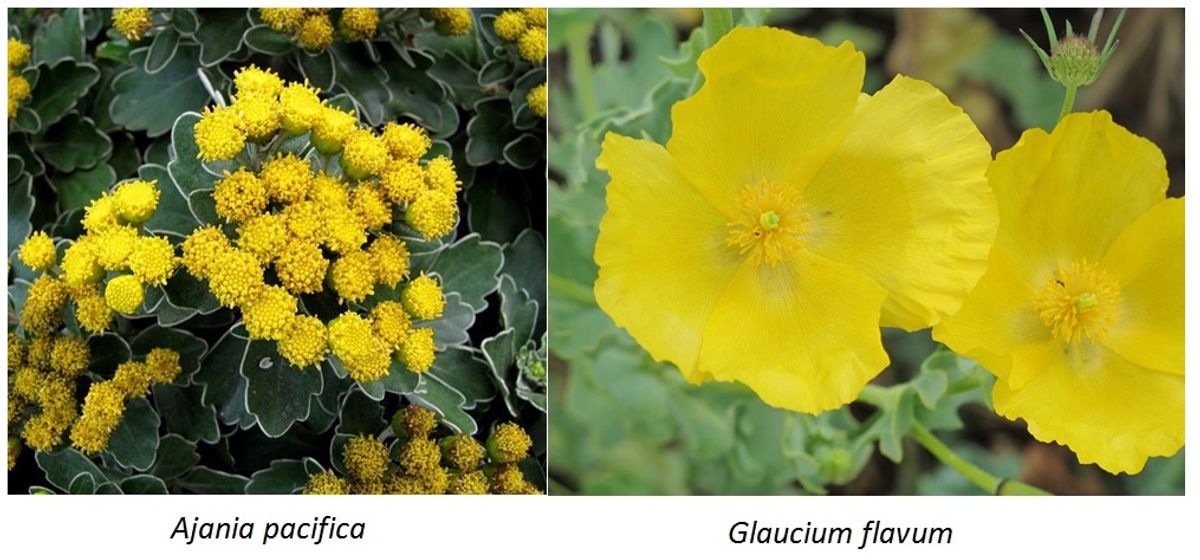
In this article we will discuss two species recently added to our nursery: Ajania pacifica and Glaucium flavum.
Ajania pacifica is an evergreen plant native to Asia and belongs to the Asteraceae family. It has lobed, ovate leaves, light green on the upper side with a silvery margin and silvery on the underside. It blooms abundantly from October to January, with yellow flowers grouped in corymbs.
Its adult size can reach 30-40 centimeters in height by 40-50 centimeters in width.
Regarding cold resistance, it belongs to climate zone 5, meaning it can withstand temperatures as low as -15°C. This makes it very interesting for areas where the temperature contrast between winter and summer is very pronounced.
As for drought resistance, it is a plant that tolerates dryness but prefers occasional watering, especially during very prolonged drought periods of more than 2 months.
This species is indifferent to whether the soil is acidic, neutral, or alkaline, as long as it has good drainage. This is particularly important during winter, as excess moisture in the soil can be harmful.
Its preferred location is in full sun, although a few hours of shade per day will not cause any harm.
It is a species very suitable for use in rock gardens, flower beds, and borders, as it blooms during a time of year when many plants do not flower, allowing for staggered garden blooms throughout the year.
Its maintenance is very simple; it is recommended to pinch back at the end of winter to rejuvenate the plant and keep it compact, forming dense mounds.
Glaucium flavum is a plant native to the Mediterranean Region belonging to the Papaveraceae family. It is a biennial or perennial plant that can be found naturally on beach dunes and cliffs.
It has tough, glaucous-green leaves with many lobes. It blooms very showily from July to September with large yellow flowers featuring four petals.
Its adult size can reach 30-40 centimeters in height by 30-40 centimeters in width.
It is a very cold-resistant species, withstanding temperatures as low as -12°C. This makes it very interesting for areas with sandy terrain and soils ranging from acidic to neutral, as it tolerates a pH between 4.5 and 7.5.
Regarding drought resistance, it is a very drought-tolerant species, so once the establishment irrigation period of 8-10 months is complete, we can stop watering this species entirely. It is a plant that tolerates environmental humidity very well. Its location should be in full sun.
This species is resistant to salinity and sea breeze, making it ideal for seafront gardens and rock gardens.
Its maintenance is very simple; it is recommended to cut the flower stem of the plant once it has finished blooming, as this will prevent the plant from behaving as a biennial, extending its life for many more years.
From Sala Graupera, we encourage you to try these two species in your gardens, and you will see how their blooms will leave you amazed.