
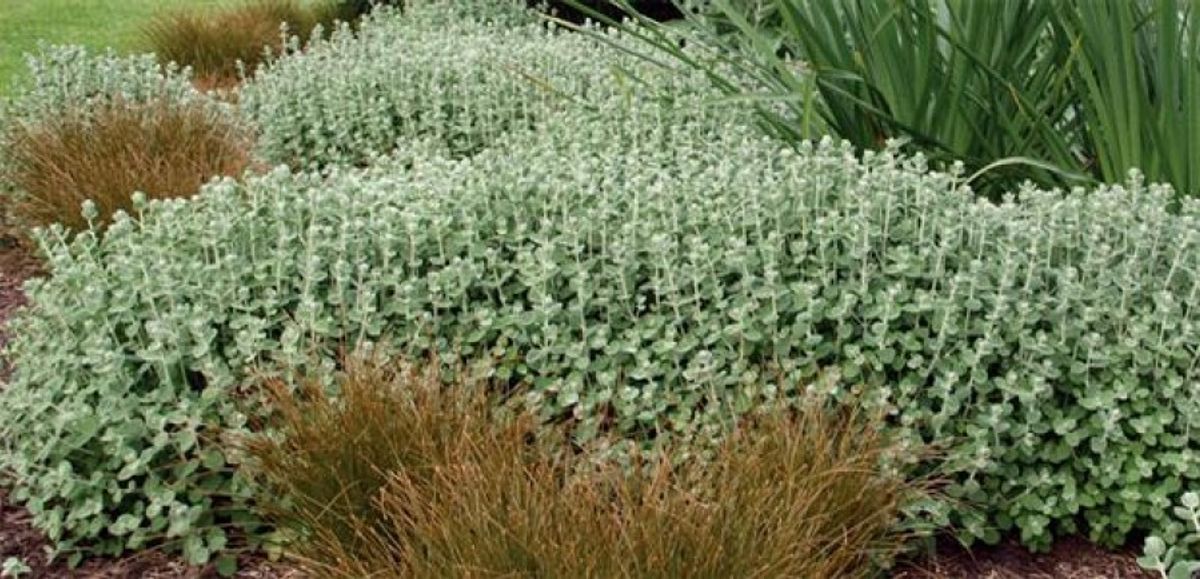
A few days before the inauguration of our demonstration garden, we will talk about a genus of species that is developing very well in it. This is the genus Ballota.
In our nursery we have three species of Ballota. Ballota acetabulosa, Ballota hirsuta and Ballota pseudodictamnus. They are species of the Lamiaceae family.
_Ballota acetabulosa_ is native to Greece and Turkey, it has dimensions when adult of 40 to 50 centimeters in height by 60 centimeters in width. It requires full sun exposure, in this way it will create a very compact rounded and natural form that is very beautiful. Belonging to hardiness zone number 8, with an average minimum annual temperature range of -12.2 / -6.7°C, showing resistance to severe frosts in our latitudes. And it is also a very drought-tolerant species, as it can go long periods of time without any watering.
Image of Ballota acetabulosa\\. Source: www.lookfordiagnosis.com
It is a shrub in which all its parts (stems, leaves and flowers) are covered with woolly hairs. It is an evergreen species, so it keeps its leaves during winter. Rounded leaves of silver color. It flowers from April to July with very discreet pink flowers.
Ballota acetabulosa tolerates lime well, and it is a species resistant to salinity and sea breeze, so it will be a useful species for gardens near the sea or for restoration of areas close to it. It needs soil with good drainage, as it does not tolerate winter moisture.
Its ideal pruning time would be in autumn, to remove withered inflorescences and to rejuvenate the plant.
\*Ballota hirsuta\*\ which is native to Spain and Portugal, differs by its round gray-green leaves, woolly. And the spikes of white and pink flowers appear in June - July, a little later than Ballota acetabulosa\.
Image of Ballota hirsuta\\. Source: www.asturnatura.com
_Ballota pseudodictamnus _ native to Greece and Turkey, is very similar to Ballota acetabulosa, but its round leaves are larger and the plant is of larger dimensions, forming large cushions with age.
Image of Ballota pseudodictamnus\\. Source: Guillem Morral
It is a very recommendable genus of plants that we encourage you to try, and it will surely give you very satisfactory results in your sustainable gardens, not so much for its flowering, but for its habit and leaf color.