
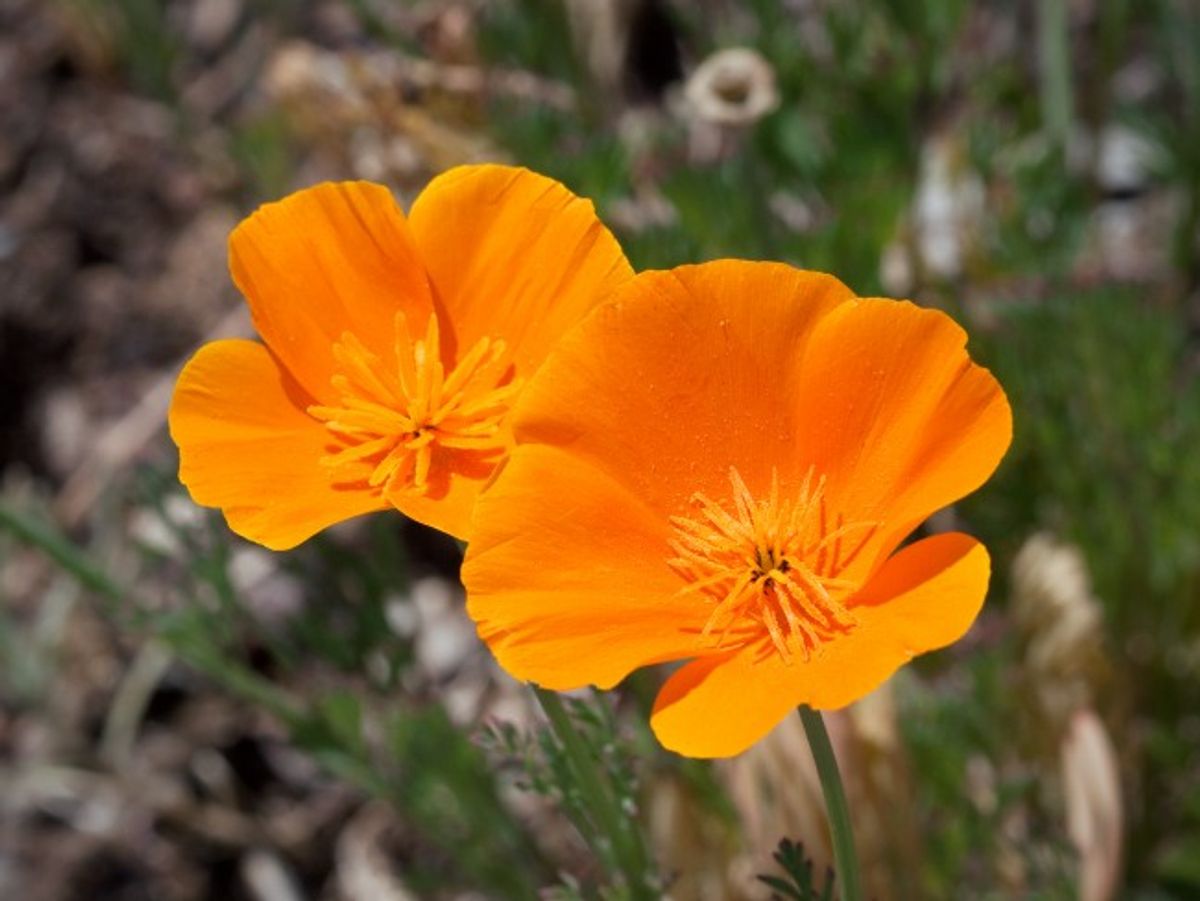
Today we will talk about a recently introduced plant in our nursery, which will soon be available to our customers. Eschscholzia californica, popularly known as California Poppy, is native to the southwestern United States. It belongs to the Papaveraceae family. Its name is due to the Russian botanist J. F. Eschscholtz, who discovered it in the California desert in the early 19th century, to later introduce it in Europe as a decorative species.
It is a perennial plant with deciduous or semi-evergreen foliage, divided into fine strips of bluish-green color. It can measure between 15/20 centimeters high by 20/30 centimeters wide, with flowers it can reach about 40 centimeters high. Its flowering period is from April to September, forming large cups of intense orange color. The petals have a brilliant reflection that makes the flowers even more luminous. These are large and solitary with four petals.
Eschscholzia sometimes behaves as an annual plant or as a short-lived perennial, but the plant reseeds so easily that it seems totally perennial. In the semi-desert areas of California, it sometimes colonizes large surfaces, giving lots of color to large hills with its bright orange corollas.
It is a species belonging to hardiness zone number 7, with an average annual minimum temperature range of -17.7 / -12.3°C, so it can tolerate very strong frosts.
It tolerates limestone well and is resistant to salinity and sea breeze, making it useful for parks and gardens near the sea. It prefers light soils with very good drainage. Good species for rock garden areas as its tolerance to stony ground is very high.
It is a very drought-resistant plant.
It must be planted in a well-sunny location, otherwise its flowers will not open while they are in the shade.
Very useful in flower beds and borders due to its abundant flowering. It is also a good ground cover to create dense non-walkable coverages. It does not require any type of pruning, which makes it a very attractive species for public parks and gardens, as its maintenance expense is almost zero.
We recommend the months from September to December for planting, always avoiding the summer months as plants could suffer severe water stress. It is also advisable to avoid the coldest months of the year such as January and February. It is advisable to use 4 to 5 plants per m2 to have an almost total ground coverage in a not very prolonged period of time.
As a curiosity, it has sedative and aphrodisiac properties.