
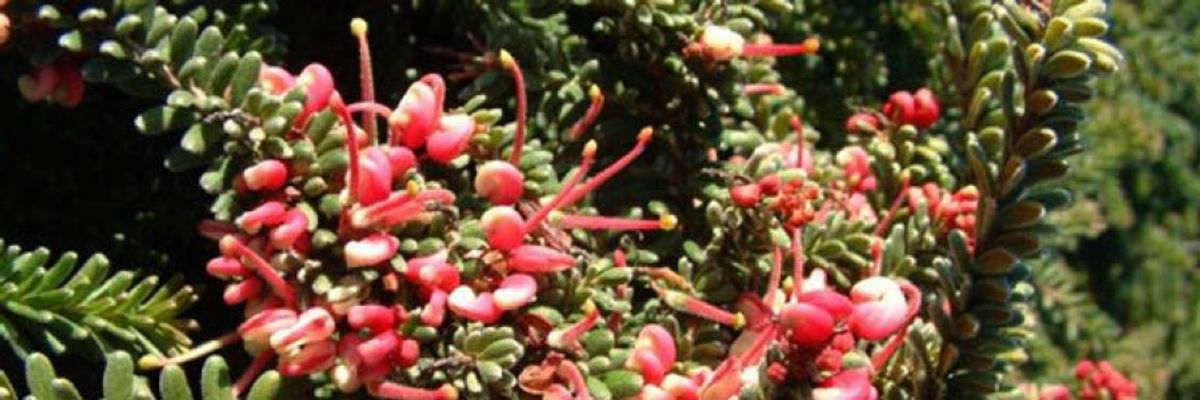
Grevilleas are a genus that belongs to the Proteaceae family. This family extends mainly in the tropical and subtropical regions of the southern hemisphere. The inflorescences of this family have a very different architecture from the flowers used in gardening in the West, which makes them especially attractive. Thus, it is a protea (P. cynaroides) that was declared, for its beauty, the national flower of South Africa.
The genus Grevillea is formed by woody plants, endemic to Australia, although some species are endemic or naturally inhabit Papua New Guinea and New Caledonia. As with many Australian plants, although species with dark green leaves can be found, glaucous is the predominant color in the leaves, with some species presenting a whitish tomentum on the underside.
---
Flowering generally takes place from late winter to early spring, although there are species or cultivars that can be found in bloom almost uninterruptedly throughout the year.
The inflorescences can be classified into:
Spider-type flowers: the curved pistils are arranged radially from a central core.
Brush-type flowers: the flowers are arranged on one side of the inflorescence.
Paintbrush-type flowers: the flowers are arranged over the entire surface of the inflorescence.
Their most characteristic feature is the presence of a long curved pistil that emerges like an antenna from the central body of the individual flower, as do the stamens. They do not have petals, in the strict sense of the botanical term.
The flowers are pollinated in their natural environment by birds and small pollen-consuming mammals, this fact being one of the attractions of these plants in their places of origin, as they attract local fauna to gardens.\\ \\
The fruits are pod or legume type, and like the inflorescences from which they come, they are very variable in their forms and can be very ornamental, with showy colorations. As Grevilleas generally reproduce sexually, that is by seed, in the absence of such pollinating agents, as in the case of European gardens, fruits or seeds are not to be expected.
From a physiological point of view, the most notable characteristics of these plants are:
Their high resistance to drought and their ability to thrive in dry and poor soils. In fact, it is advisable to avoid fertile soils and, in general, the contribution of phosphoric fertilizers. The root system of Grevilleas is superficial and sensitive to damage and physical injuries, which discourages mechanical weeding or cultivation of the feet.
Their ecological requirements are limited to exposures as sunny, ventilated and open as possible and to rather acidic and well-drained soils. Therefore in soils of basic character, plants may suffer chlorosis, which should be corrected with applications of iron chelates either in irrigation water or with foliar applications. But some species such as G. olivacea or the cultivar "Wimpara Gem" are characterized by having a greater tolerance to alkaline and calcareous soils.
The best time to plant is in autumn, especially if the location is in a distinctly Mediterranean climate. With early planting it is favored that the young plant can reorganize its root system and colonize the surrounding substrate, taking advantage of the benevolence of winter conditions, to prepare for the dry season.
Once established, plants will not need more water than rainfall, but the first or two years of planting will appreciate some watering, which will preferably be spaced in time and generous with water.
Regarding fertilization, considering the frugality of these plants, it is not necessary to apply fertilizers of any kind. If used, slow-release products should be used, with a very low phosphorus content. Preferably they will be applied in spring and accompanied by water inputs, either through rain or irrigation. The application of organic products can provide, after mineralization, the nutritional elements, at the right pace and proportions, for these plants.
Grevilleas have no pests or diseases of consideration. If the presence of a local parasite is observed that needs to be eradicated, the usual active ingredients and phytosanitary products will be sufficient.
Pruning is highly recommended to shape the plant and stimulate branching and flowering the following year, it will be done in summer after flowering. In general, pruning consists of the elimination and shortening of already flowered shoots in a variable length, which can range from 10 or 15 centimeters to a third of their length. The intensity of pruning varies depending on the type of flower of the species. Species with paintbrush-type inflorescence can be pruned more heavily than species with spider-type flowers.
In the next post about Grevilleas, one of the most representative plant genera of Viveros Sala Graupera, we will explain the particular characteristics of its most outstanding species and cultivars.